Foundations First: How Japanese Structural Medicine Is Uncovering the Spinal Crisis Americans Don't Know They Have
Back pain is the second most common reason Americans visit a doctor. It costs the United States an estimated $635 billion annually in treatment and lost productivity. And yet, for the majority of sufferers, the conversation begins only after the damage is done — after the disc has herniated, the vertebra has shifted, or the nerve has been compressed for long enough to demand attention.
Japanese structural medicine asks a different question entirely: what if the crisis was visible long before it became painful?
A Different Starting Point
In Japan, the clinical tradition of evaluating the body as a structural whole — rather than treating isolated complaints — has roots that stretch back through centuries of practice in disciplines like seikotsu (bone-setting), judo therapy, and traditional manual assessment. Practitioners trained in these lineages are taught to observe the body standing still, in motion, and under load. They are looking not for the site of pain, but for the originating distortion that made pain inevitable.
This distinction matters enormously. Western orthopedic imaging is extraordinarily good at documenting what has already gone wrong. An MRI can reveal a herniated disc with remarkable precision. What it cannot tell you is whether the patient's left hip has been rotated anteriorly for fifteen years, gradually loading the lumbar spine in a pattern that made that herniation a near-mathematical certainty.
Japanese structural practitioners, by contrast, are trained to read that hip rotation — and a dozen related compensatory patterns — long before imaging would reveal any pathology at all.
The Concept of Structural Integrity
At the heart of Japanese postural medicine is a principle that translates roughly as structural integrity — the idea that the skeleton functions as a unified load-bearing system, and that any deviation from optimal alignment creates cumulative mechanical stress that compounds over time. This is not a mystical concept. It is, in fact, entirely consistent with modern biomechanics. But the Japanese clinical tradition has been applying it systematically for far longer than Western sports medicine has.
Practitioners assess the relationship between the pelvis and the lumbar spine, between the thoracic cage and the cervical vertebrae, and between the position of the feet and the trajectory of force through the entire skeletal chain. A patient who presents with neck pain may be assessed primarily at the level of the pelvis, because the Japanese structural view holds that the foundation determines what is built upon it.
For American patients accustomed to being asked simply, "Where does it hurt?" this approach can feel disorienting at first. At Nishino Central Wellness, we find that most patients quickly come to appreciate the logic: a building with a tilted foundation does not need a better roof. It needs its foundation corrected.
What Early Intervention Actually Looks Like
One of the most significant contributions Japanese structural medicine can make to American healthcare is the concept of meaningful early intervention — not the generic advice to "strengthen your core" or "sit up straight," but a precise, individualized assessment of how a specific body is compensating and why.
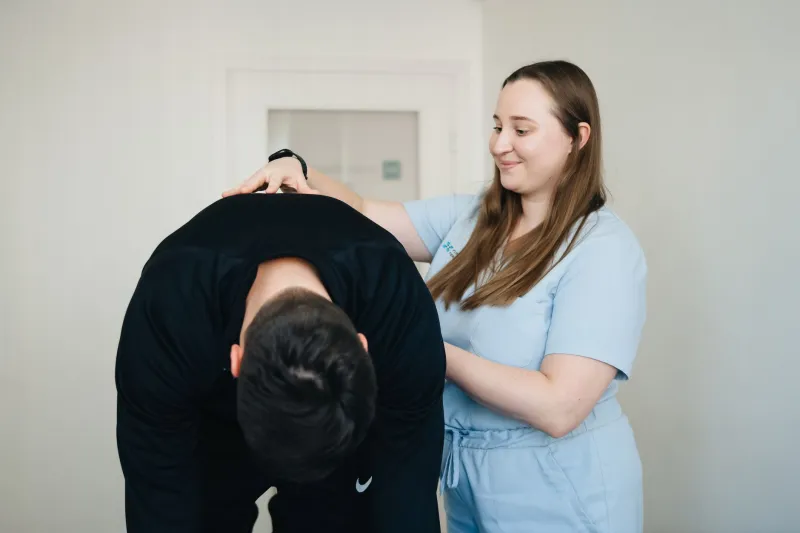
In practice, this means a thorough postural evaluation that maps the patient's standing alignment against established structural reference points. It means assessing gait, identifying asymmetries in shoulder height and pelvic tilt, and examining the relationship between foot mechanics and spinal loading. It means asking about occupational postures, sleep positions, and the history of old injuries that may have been dismissed as healed but left lasting structural traces.
From this assessment, a structured course of manual therapy, corrective exercise, and postural re-education can be designed — not to treat a symptom, but to address the underlying pattern before it matures into pathology.
The American Orthopedic Gap
It is worth being direct about what is missing in the standard American orthopedic pathway. A patient who visits their primary care physician with mild, recurring back pain is likely to receive imaging only if symptoms are severe or persistent, a referral to physical therapy that may or may not address underlying postural patterns, and a prescription for anti-inflammatory medication to manage discomfort in the interim.
This is not negligence. It is a system designed around acute intervention rather than structural prevention. The problem is that mild, recurring back pain is often the body's earliest legible signal that something foundational is wrong — and that signal is frequently managed rather than investigated.
Japanese structural medicine positions itself precisely in this gap. It is most valuable not when the disc has already herniated, but in the years before that event, when careful assessment and consistent correction could have changed the outcome entirely.
Genetics, Age, and the Convenient Excuses
Americans are often told that their spinal problems are a function of genetics or the inevitable consequence of aging. Both explanations contain partial truth, but both are also used to foreclose conversations that should be happening.
Genetics may predispose a person to certain structural vulnerabilities. But vulnerability is not destiny. A structurally sound body with genetic predispositions toward disc degeneration will age differently than a structurally compromised body with the same genetic profile. The variable that too often goes unexamined is the decades of postural loading that occurs between birth and the first orthopedic appointment.
Similarly, while some degree of spinal change is associated with aging in every population, the rate and severity of that change is not fixed. Populations that maintain strong postural habits — supported by cultural practices, occupational norms, and regular manual care — demonstrate meaningfully different patterns of age-related spinal change than those that do not.
Bringing the Tradition Forward
At Nishino Central Wellness, our approach to structural care draws on these Japanese assessment traditions while integrating them with contemporary anatomical understanding and evidence-based rehabilitation principles. We believe that the most important conversation in American spinal health is the one that happens before the MRI — the careful, whole-body assessment that asks not what has broken, but why it was always likely to.
The silent epidemic of spinal degeneration in America is not silent because it is hidden. It is silent because the healthcare system has not yet built the infrastructure to hear it. Japanese structural medicine has been listening for centuries. It is time American patients had access to that conversation.
If you are experiencing early or recurring back, neck, or joint discomfort — or if you simply want to understand what your posture may be forecasting about your future — we invite you to schedule a structural assessment at Nishino Central Wellness. Prevention, when it is genuine and precise, is always the most powerful form of care.