Rhythm Over Restriction: Why the Clock on Your Plate Matters More Than the Diet on Your Shelf
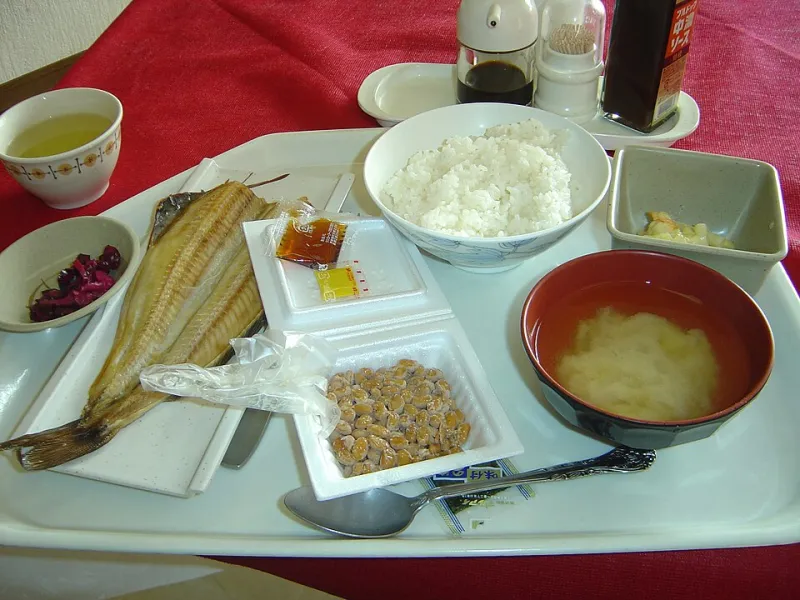
Photo: David Monniaux, CC BY-SA 3.0, via Wikimedia Commons
Every January, the same ritual repeats in American households: a new diet, a pantry purge, a resolution. And every December, the statistics tell us how it went. Roughly three-quarters of American adults now carry excess weight or a metabolic diagnosis, despite — or perhaps because of — the most diet-saturated culture on earth.
At our clinic, we have come to believe the question itself is wrong. Traditional Japanese dietary medicine rarely begins with what. It begins with when, how, and at what temperature. Call it rhythm medicine. The evidence for it is quietly compelling.
The American Eating Day Is Structurally Broken
Consider the typical rhythm, not the typical menu. Breakfast skipped or consumed while driving. Lunch eaten in fifteen minutes at a desk, often while typing. Dinner at nine, eaten in front of a television. Ice water with every meal. Snacks bridging every gap.
Each of these habits is individually normalized. Together they form a pattern that circadian biologists now recognize as metabolically hostile: eating at hours when insulin sensitivity is lowest, eating too quickly for satiety signals to register, drinking cold liquids that (per traditional East Asian medicine and some modern observation) blunt digestive comfort, and never giving the gut a defined period of true rest.
What Japanese Meal Rhythm Medicine Teaches
Kampo and classical East Asian medicine have long described digestion as a fire — strongest in the morning hours, weakest at night. Modern chrononutrition has arrived at a strikingly similar conclusion through different doors: studies of time-restricted eating consistently show that shifting calories earlier in the day improves glucose response, even when the food itself is unchanged.
Traditional Japanese meal structure encodes this wisdom without requiring a single calculation:
- Ichijuu-sansai — one soup, three dishes — creates a complete but modest meal with built-in portion logic
- Warm rice and miso soup at breakfast anchor the day's first meal in warmth and easy digestion
- Meals are taken seated, at a table, without work — a cultural rule that slows the fork automatically
- Hot tea, never iced water, accompanies the meal
- The kitchen closes after dinner. Late-night eating is simply not part of the pattern
Notice that none of this is a diet. Nothing is forbidden. The structure itself does the regulatory work.
Why Restriction Fails and Rhythm Holds
Restriction asks the willpower to win three times a day, forever. Rhythm asks the environment to make the right choice the default choice. Behavioral science has known for decades which of these wins in the long run.
There is also a dignity question. Restriction frames the eater as a problem to be corrected. Rhythm frames the eater as a participant in a pattern older than themselves — breakfast as ceremony, lunch as pause, dinner as return. Patients in our practice who adopt the structure often describe an unexpected psychological benefit: food stops being an adversary.
A Practical Proposal for American Eaters
You need not adopt a Japanese table wholesale. Start with three structural changes:
Anchor breakfast with warmth. Whatever you eat, make it warm and make it before nine. Miso soup and rice is ideal; oatmeal works; even warm tea with toast beats a cold smoothie in the car.
Give lunch a boundary. Twenty minutes, seated, away from the screen. The meal ends when the plate is done, not when the inbox is clear.
Close the kitchen. Choose a time — say, three hours before bed — after which nothing but water or warm tea passes your lips. Protect that boundary the way you'd protect a meeting.
Two weeks of this will tell you more about your body than any elimination diet. The scale may move. But the more meaningful changes — steadier energy, calmer digestion, fewer 3 p.m. crashes — tend to arrive first, and they arrive not because you ate differently, but because you finally ate on time.