The Stillness Trap: How the Quest for Perfect Posture Is Quietly Breaking American Bodies
Walk into any corporate wellness seminar in the United States, and you will almost certainly encounter a slide featuring a silhouette with a perfectly vertical spine, shoulders drawn back with military precision, chin tucked at exactly ninety degrees. The message is clear: achieve this shape and your pain will disappear. Hold it long enough and your body will thank you.
Japanese structural medicine, however, offers a quietly radical counter-argument. The problem with chronic pain in postural contexts is rarely that Americans are holding the wrong shape. The problem is that they are holding any shape at all—for hours, for days, for years—without meaningful variation.
At Nishino Central Wellness, our practitioners draw on centuries of Japanese anatomical observation to reframe what healthy posture actually means. The answer is not a position. It is a practice.
The Myth of the Neutral Spine
Western ergonomics developed largely in response to industrial and office work environments. The goal was standardization: find the biomechanically optimal arrangement of body segments and instruct workers to maintain it. This approach has intuitive appeal, and in short bursts, it is not without merit.
The difficulty arises when that optimal arrangement becomes a mandate for stillness. The human spine evolved over millions of years to carry a body that walked, crouched, climbed, twisted, and rested in a dozen different configurations throughout any given day. Its architecture—the intervertebral discs, the facet joints, the deep stabilizing musculature—is designed to distribute load through movement, not to sustain it through rigidity.
When an individual holds a fixed posture for extended periods, even an anatomically 'correct' one, several damaging processes begin. Intervertebral discs, which rely on the pumping action of movement to receive nutrients and expel waste, begin to dehydrate. Deep spinal stabilizers—muscles like the multifidus and transversus abdominis—begin to disengage because they are no longer being challenged to respond to dynamic shifts in load. And the postural muscles tasked with maintaining that rigid alignment fatigue progressively, eventually generating the very tension and pain the posture was supposed to prevent.
What Japanese Structural Observation Reveals
Traditional Japanese approaches to structural health—including practices rooted in classical shiatsu assessment, martial arts body mechanics, and the postural principles embedded in disciplines like noh theater and tea ceremony—share a foundational understanding that the body is most resilient when it is most responsive.
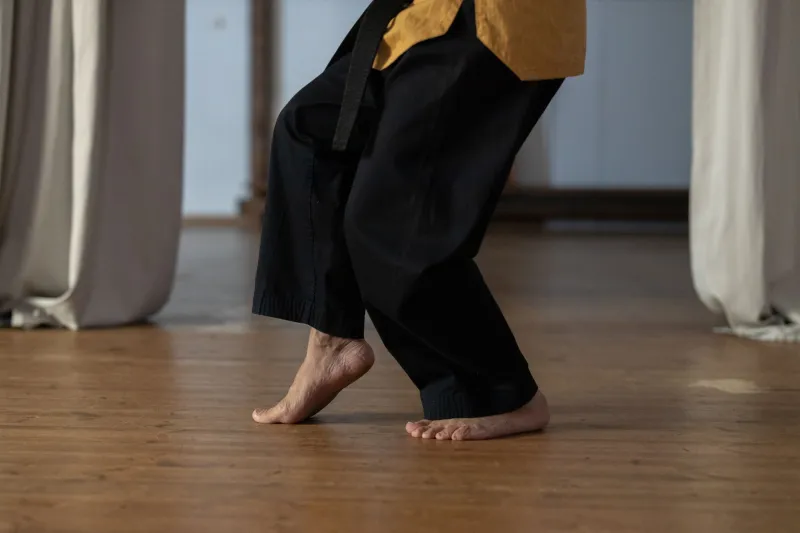
In these traditions, good posture is not described as a fixed coordinate in space. It is described as readiness: a state of organized, alert availability in which the body can move efficiently in any direction with minimal effort and maximum adaptability. The Japanese concept of kamae—a term from martial arts denoting a prepared, balanced stance—captures this idea precisely. A practitioner in kamae is not frozen. They are poised.
This distinction has direct clinical implications. Japanese structural practitioners assess not just where a patient's body rests, but how freely it moves out of that rest. Restrictions in thoracic rotation, limitations in lumbar flexion, and the inability to shift weight fluidly from one leg to the other are read as diagnostic signals—evidence that the body has traded adaptability for a kind of false stability.
The Breathing Consequence Nobody Mentions
One of the most underappreciated consequences of rigid postural holding is its effect on respiration. The thoracic spine, ribs, and diaphragm form an integrated mechanical system. When the thoracic cage is locked into a sustained position—even a well-intentioned upright one—the natural excursion of the ribs during breathing becomes restricted.
Over time, this restriction trains the body to rely on accessory breathing muscles: the scalenes, the sternocleidomastoid, the upper trapezius. These muscles are not designed for the continuous labor of primary respiration. Their chronic overuse contributes to neck tension, headaches, and the upper-body tightness that millions of Americans associate simply with stress—when it is, in significant part, a postural and respiratory dysfunction.
Japanese breathing traditions, which inform many of the therapeutic approaches at Nishino Central Wellness, consistently emphasize the relationship between spinal mobility and respiratory freedom. A spine that moves is a spine that breathes. A spine that is held does not.
Muscle Atrophy in Disguise
Perhaps the most counterintuitive consequence of rigid postural discipline is muscular atrophy. Americans who invest significant effort in maintaining 'correct' posture often report that they feel stronger and more controlled. In many cases, the opposite is occurring at the deeper muscular level.
When the body is held in a fixed position, the nervous system learns to rely on passive structural support—ligaments, joint capsules, fascial tension—rather than active muscular engagement. The deep stabilizers that should be continuously calibrating and recalibrating in response to subtle postural shifts are, in effect, laid off. The result is a body that looks upright but is structurally fragile: dependent on its own rigidity rather than its own strength.
Japanese therapeutic exercise traditions address this by emphasizing controlled instability: exercises and movement patterns that deliberately challenge the body's capacity to find balance in motion. These approaches bear some resemblance to contemporary Western concepts like proprioceptive training, but they are grounded in a far older understanding of how the human body learns to organize itself.
Postural Fluidity as Clinical Practice
At Nishino Central Wellness, addressing postural dysfunction begins not with instruction in correct positioning, but with assessment of movement restriction. Practitioners identify where the body has lost its capacity for fluid, effortless transition—between sitting and standing, between rotation and extension, between effort and ease.
Treatment may incorporate manual therapy to restore mobility in restricted spinal segments, targeted work on the deep stabilizing musculature, and guided movement re-education that teaches patients to inhabit their bodies dynamically rather than statically. Patients are encouraged to think of posture not as a shape they must achieve, but as a quality of attention they cultivate throughout the day.
This means moving more, not less. It means micro-adjustments, brief walks, deliberate transitions. It means allowing the spine to flex, extend, and rotate as it was designed to do—not as a sign of postural failure, but as the very expression of postural health.
The most important thing a rigid spine cannot do is heal itself. Movement is not the enemy of good posture. It is its foundation.