Where Ancient Touch Meets Modern Science: Japanese Bodywork and the Fascial System
For most of Western medicine's history, fascia was an afterthought. Medical students learned to remove it during dissection — cutting through the white, fibrous connective tissue that sheaths every muscle, organ, nerve, and bone in the human body — in order to reach the structures they were actually studying. Fascia was considered scaffolding. Packaging. Something to be cleared away.
That view has changed dramatically in recent years. Fascial research has emerged as one of the most dynamic frontiers in musculoskeletal medicine, revealing that this once-dismissed tissue is in fact a continuous, fluid, mechanically active system that plays a central role in movement, pain, proprioception, and even immune function. The implications for pain management are profound.
What makes this scientific revolution particularly interesting — and particularly relevant to the work we do at Nishino Central Wellness — is that traditional Japanese bodywork practitioners appear to have understood the fascial system, intuitively and practically, for centuries before Western science named it.
The Fascial Web: What Modern Research Has Revealed
Fascia is not a collection of separate structures. It is a single, body-wide network of connective tissue — a three-dimensional web that interpenetrates and surrounds every anatomical structure in the body. Under tension, it transmits force across distances that traditional anatomical models would never have predicted. A restriction in the plantar fascia of the foot, for instance, can influence tension patterns all the way up through the hip and into the thoracic spine.
Researchers at institutions including Harvard Medical School and the Fascia Research Congress have demonstrated that fascia is richly innervated — containing more sensory nerve endings than the muscles it surrounds. It responds to mechanical pressure, hydration, temperature, and even emotional stress. When fascia becomes restricted or dehydrated — through injury, poor posture, chronic tension, or repetitive movement patterns — it can generate pain, limit range of motion, and disrupt the body's movement efficiency in ways that do not show up on standard imaging.
This is why many patients with chronic pain receive normal MRI results and yet continue to suffer. The problem is not in the bones or the discs. It is in the fascial matrix that surrounds them.
Japanese Bodywork Traditions and the Fascial System
Traditional Japanese manual therapy — including Anma, Shiatsu, and the structural assessment methods of classical Japanese osteopathic practice — was never organized around the anatomical categories of Western medicine. Practitioners did not think in terms of individual muscles and isolated joints. They thought in terms of continuous lines of tension and release, of pathways through which vital energy and physical force traveled through the body.
The meridian system of classical Japanese and Chinese medicine, long dismissed by Western practitioners as fictional, maps with striking accuracy onto the fascial planes and myofascial chains that modern researchers have identified. The bladder meridian, which runs in two parallel lines down either side of the spine before sweeping down the back of the leg, corresponds closely to what contemporary fascial anatomy calls the superficial back line — a continuous myofascial track that transmits tension from the plantar fascia at the sole of the foot to the epicranial fascia at the crown of the head.
This is not coincidence. It is evidence that practitioners working with their hands over centuries of clinical observation were mapping a real physiological system — one that Western anatomy, with its cadaver-based, dissection-focused methodology, was structurally unable to perceive.
Shiatsu and Myofascial Release: A Therapeutic Convergence
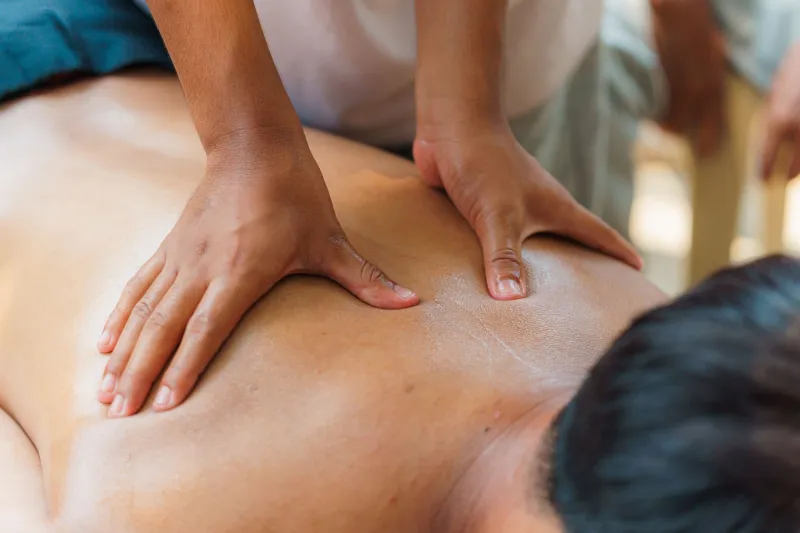
Shiatsu therapy — the Japanese bodywork modality that applies sustained, rhythmic pressure along meridian pathways using the thumbs, palms, elbows, and knees — produces effects that fascial research now helps explain mechanically.
Sustained pressure applied to fascial tissue triggers a process called thixotropy: the gel-like ground substance of the fascial matrix becomes more fluid under mechanical stimulation, allowing restrictions to release and hydration to be restored. This is precisely the mechanism that makes skilled Shiatsu so effective for patients with chronic tension patterns that have not responded to more superficial forms of massage.
The sustained holds characteristic of Shiatsu — pressure maintained for several seconds rather than applied in brief strokes — appear to be particularly significant. Fascial research suggests that the tissue requires approximately 90 to 120 seconds of sustained load before it begins to respond with meaningful viscoelastic change. Practitioners trained in classical Shiatsu have always known this intuitively, even without the biochemical vocabulary to explain it.
Structural Assessment Through a Fascial Lens
One of the most clinically valuable contributions of fascial research is the concept of tensegrity — the idea that the body maintains its structural integrity not through rigid compression but through a dynamic balance of tension distributed across the fascial network. When one part of the tensegrity structure is disrupted, compensatory patterns emerge elsewhere in the system.
Japanese structural medicine has long employed a form of whole-body postural assessment that reflects this understanding. Rather than treating the site of pain in isolation, practitioners evaluate the entire body's tension pattern — looking for the upstream restrictions that are generating the downstream symptoms. A patient presenting with chronic neck pain, for instance, may be assessed and treated primarily at the hip flexors and thoracolumbar fascia, where the primary restriction is identified.
This approach can seem counterintuitive to patients accustomed to Western pain management, which tends to focus treatment at the site of reported discomfort. But for patients with chronic pain that has persisted despite conventional care, this systemic fascial perspective often represents the missing piece.
What This Means for American Patients
For the millions of Americans living with chronic musculoskeletal pain — back pain, neck pain, plantar fasciitis, shoulder impingement, temporomandibular dysfunction — the convergence of Japanese bodywork tradition and fascial science offers a genuinely new therapeutic possibility.
At Nishino Central Wellness, our practitioners integrate classical Japanese manual therapy techniques with a contemporary understanding of fascial anatomy and biomechanics. This means that patients receive care that is both historically grounded — drawing on a clinical tradition refined over centuries — and scientifically informed by the most current research in connective tissue physiology.
The ancient practitioners who first mapped the meridian lines did not have access to electron microscopes or force plate analysis. But they had something equally valuable: thousands of hours of attentive clinical observation, and the wisdom to trust what their hands were telling them.
Modern science is now confirming what those hands already knew. And at Nishino Central Wellness, we are honored to practice at the intersection where that ancient knowledge and contemporary understanding meet.