The Forgotten Fluid: How Japanese Hara and Meridian-Based Drainage Practices Are Quietly Outpacing America's Detox Obsession
The Detox Industry's Dirty Secret
Every January, American wellness culture undergoes a familiar ritual. Supplement shelves restock with liver-cleansing capsules. Social media fills with before-and-after photos from seven-day juice fasts. Celebrities endorse activated charcoal tonics and infrared sauna memberships. The detox industry in the United States generates well over $50 billion annually—and yet, a growing body of clinical evidence suggests that many of its most popular offerings accomplish little beyond lightening consumers' wallets.
The liver and kidneys already filter waste with remarkable efficiency. The lymphatic system, however, is a different story. Unlike the cardiovascular system, which has the heart as its dedicated pump, the lymphatic network depends entirely on movement, breath, and manual stimulation to circulate its fluid. When lymph stagnates—as it commonly does in sedentary, stressed, or nutritionally compromised individuals—the consequences can be wide-ranging: persistent bloating, immune dysregulation, fatigue, and a general sense of physical heaviness that no supplement can fully address.
This is precisely where traditional Japanese therapeutic approaches have something urgent and underappreciated to offer.
What Is Lymphatic Stagnation, and Why Does It Matter?
The lymphatic system is a network of vessels, nodes, and organs responsible for transporting immune cells, filtering cellular waste, and maintaining fluid balance throughout the body. When functioning optimally, it acts as both a highway for immune surveillance and a drainage system for metabolic byproducts. When it slows—due to inactivity, chronic tension, poor posture, or accumulated fascial restriction—tissues can become congested, inflammatory responses may intensify, and immune function can falter.
Clinical research has increasingly linked lymphatic inefficiency to conditions ranging from chronic edema and fibromyalgia to post-surgical complications and autoimmune flares. A 2019 review published in the Journal of Anatomy highlighted the lymphatic system's critical role in neurological waste clearance, connecting poor lymphatic circulation to cognitive fatigue and even early markers of neurodegenerative disease. Despite this, most mainstream detox protocols make no meaningful attempt to address lymphatic flow—focusing instead on dietary restriction or supplementation that bypasses the physical mechanics of drainage entirely.
The Hara: Japan's Map of the Body's Interior
In traditional Japanese medicine, the abdomen holds a significance that has no direct equivalent in Western anatomy. Known as the hara, this region is understood not merely as a digestive cavity but as the body's energetic and physiological center—a convergence point for vital organ function, nervous system regulation, and the meridian pathways that govern the body's internal communication network.
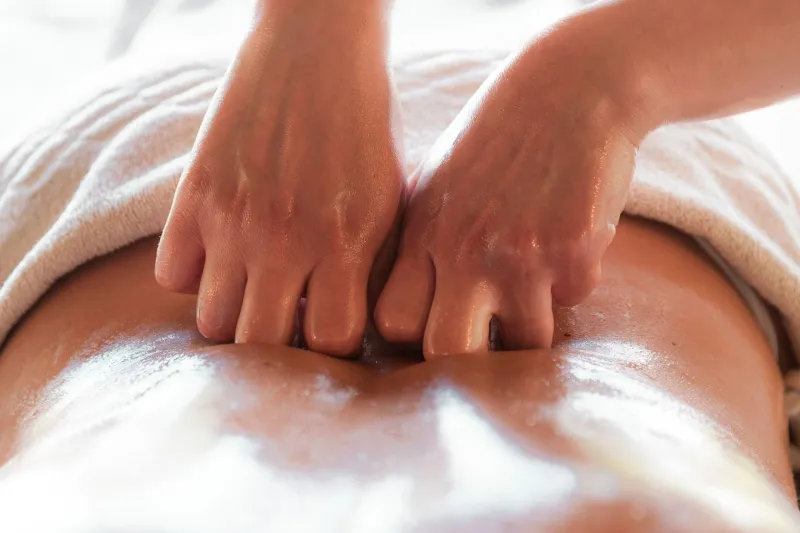
Hara diagnosis (fukushin) has been practiced in Japan for over a millennium, originally as a means of assessing the health of internal organs through careful palpation of the abdominal surface. Skilled practitioners could detect areas of tension, hollowness, or abnormal pulsation that corresponded to specific organ systems and meridian imbalances. This diagnostic tradition evolved into targeted therapeutic intervention: structured abdominal massage techniques designed to mobilize stagnant fluid, release fascial adhesions, and stimulate the lymphatic vessels concentrated throughout the mesenteric tissue of the gut.
Contemporary integrative medicine has begun to validate what Japanese practitioners have long understood. The gut's mesentery—once dismissed as mere connective tissue—was reclassified in 2017 as a distinct organ by researchers at the University of Limerick, drawing renewed attention to the dense network of lymphatic vessels it contains. Gentle, rhythmic abdominal manipulation directly engages this tissue, encouraging lymphatic flow in ways that no dietary supplement can replicate.
Meridian Pathways and the Lymphatic Connection
Beyond the hara, traditional Japanese medicine maps the body through a system of meridians—energetic channels through which ki (vital force) is said to flow. While the meridian concept originated in Chinese medicine, Japanese practitioners developed their own distinct interpretations and manual techniques, placing particular emphasis on palpatory sensitivity and the use of lighter pressure than their continental counterparts.
Interestingly, anatomical research has identified a meaningful spatial correlation between classical meridian pathways and the distribution of lymphatic vessels and fascial planes. A 2020 study in Scientific Reports found that acupuncture points along several major meridians corresponded with areas of elevated interstitial fluid concentration—precisely the zones where lymphatic stimulation would have the greatest physiological effect. This does not confirm the metaphysical dimensions of meridian theory, but it does suggest that centuries of empirical observation produced a functional map of the body's fluid dynamics long before modern imaging technology existed.
Techniques such as sotai (corrective movement therapy), structured shiatsu sequences targeting lymphatic nodes, and the gentle abdominal work central to traditional Japanese therapeutic massage all operate along these pathways—mobilizing fluid, releasing tension, and supporting the body's innate drainage mechanisms.
Why American Wellness Culture Missed This
The American wellness market has historically favored interventions that are visible, quantifiable, and commercially scalable. A green juice can be bottled, branded, and sold in every Whole Foods from Portland to Miami. A structured abdominal drainage session requires a trained practitioner, patient time, and a degree of anatomical literacy that resists commodification.
There is also a cultural dimension at play. Western medicine's long-standing skepticism toward manual therapies—particularly those rooted in non-Western traditions—created an institutional barrier that slowed research investment and clinical adoption. Only in the past two decades have lymphatic drainage techniques gained meaningful recognition in mainstream US healthcare, largely through their application in post-mastectomy care and management of lymphedema following cancer treatment.
Yet even as manual lymphatic drainage has earned clinical legitimacy in those specific contexts, its broader wellness applications remain underutilized. Japanese-derived techniques, which approach lymphatic health as a foundational aspect of everyday care rather than a post-pathology intervention, offer a more comprehensive and preventive framework.
Integrating Japanese Drainage Practices Into a Modern Wellness Routine
For individuals seeking to support lymphatic health without committing to restrictive protocols or expensive supplement regimens, several evidence-informed approaches drawn from Japanese tradition are worth exploring.
Structured abdominal self-massage based on hara principles can be practiced daily, using gentle clockwise circular movements to stimulate mesenteric lymphatic flow and support digestive motility. Even five to ten minutes performed consistently can produce measurable improvements in bloating and bowel regularity.
Meridian-based shiatsu sequences targeting the spleen, stomach, and large intestine channels—organs central to fluid metabolism in Japanese medical theory—can be administered by a trained practitioner to address deeper stagnation and fascial restriction.
Diaphragmatic breathing exercises, a cornerstone of Japanese therapeutic practice, activate the thoracic duct—the body's largest lymphatic vessel—through the mechanical pressure changes generated by deep, rhythmic respiration. This requires no equipment and can be integrated into any existing wellness routine.
Sotai corrective movement, developed by Dr. Keizo Hashimoto in the twentieth century, uses gentle resistive movements to release structural tension that impedes lymphatic and circulatory flow—addressing root causes rather than surface symptoms.
A More Honest Conversation About Detoxification
The appeal of the detox industry is understandable. People feel congested, sluggish, and inflamed—and they want solutions that are accessible and immediate. The problem is not the desire for better health; it is the mismatch between what is being sold and what the body actually needs.
The lymphatic system does not respond to kale smoothies. It responds to movement, breath, skilled touch, and the kind of patient, systematic attention to the body's internal geography that Japanese healing traditions have cultivated for generations. As integrative medicine continues to build its evidence base, the clinical logic underlying these ancient practices becomes increasingly difficult to dismiss.
At Nishino Central Wellness, we believe that genuine detoxification is not a product you purchase—it is a process you support, through practices grounded in both traditional wisdom and modern anatomical understanding. The lymph problem that nobody is talking about has a solution. It simply requires looking east.