When the Body Holds What the Mind Cannot: Japanese Somatic Healing and the Physiology of Stored Trauma
For decades, the dominant American model of trauma treatment has centered on the mind. Cognitive behavioral therapy, psychoanalysis, medication — these are the tools most clinicians reach for when a patient arrives carrying the invisible weight of unprocessed emotional experience. Yet a growing body of neuroscientific research is raising an uncomfortable question: what happens to the trauma the mind cannot fully articulate? Where does it go?
According to traditional Japanese medicine, the answer has always been clear. It goes into the body.
Ki, Kyo, and the Architecture of Emotional Blockage
At the foundation of Japanese healing philosophy is the concept of ki — the animating life force that circulates through the body along defined pathways known as meridians. In a state of health, ki moves freely, sustaining vitality and maintaining equilibrium between the physical, emotional, and spiritual dimensions of a person's experience. Disruption of that flow, whether caused by injury, illness, or unresolved psychological stress, is understood not merely as a metaphysical concern but as a clinical one with measurable consequences.
Japanese practitioners distinguish between areas of jitsu — regions of excess or congestion — and kyo — areas of depletion or hollowness. Emotional trauma, in this framework, tends to manifest as jitsu: a holding, a bracing, a densification of tissue that reflects the body's attempt to contain what has not yet been processed. Over time, these areas of congestion consolidate into patterns of chronic tension that resist conventional treatment because their origin is not structural — it is experiential.
This is not mysticism. It is increasingly recognized as biology.
What the Fascia Remembers
Western anatomy has only recently begun to appreciate the fascia — the continuous web of connective tissue that envelops every muscle, organ, nerve, and bone in the human body — as a system of genuine clinical significance. Research emerging from institutions such as Harvard Medical School and the Fascia Research Congress has demonstrated that fascial tissue is densely populated with mechanoreceptors and nociceptors, making it highly responsive to both physical force and emotional state.
The work of Dr. Bessel van der Kolk, author of The Body Keeps the Score, and somatic researcher Peter Levine has established that traumatic experience activates the autonomic nervous system in ways that, when the threat response is never fully discharged, become encoded in musculoskeletal holding patterns. The diaphragm tightens. The psoas contracts. The thoracic spine rounds forward in a posture of self-protection. These are not metaphors — they are measurable physical adaptations to psychological events that the nervous system never received permission to complete.
Japanese bodywork traditions, particularly shiatsu and the older practice of anma, have been working with precisely these patterns for centuries. The practitioner's trained hand does not simply address the surface complaint. It seeks the deeper texture of the tissue — its temperature, its responsiveness, its degree of aliveness — and uses that information to locate the regions where ki has stagnated and the body has, in effect, frozen itself around an old wound.
The Neuroscience of Somatic Release
Understanding why Japanese somatic techniques produce results that verbal therapy sometimes cannot requires a brief excursion into neuroanatomy. The brain's threat-processing center, the amygdala, does not operate through language. It operates through sensation, image, and felt experience. Trauma memories stored in subcortical structures are not accessible through the prefrontal cortex — the region engaged in rational reflection and conversation — in any direct way. This is why a person can discuss a traumatic event with apparent composure yet continue to experience its physiological signature in the form of hypervigilance, chronic pain, or digestive dysfunction.
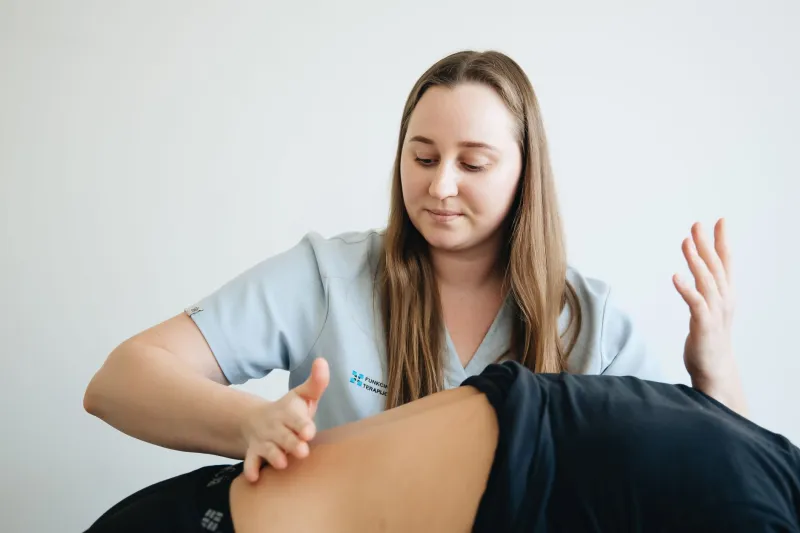
Somatic interventions bypass this limitation by working through the body's own sensory channels. Sustained, attentive pressure applied to areas of fascial restriction activates the parasympathetic nervous system, signaling to the amygdala that the environment is safe. This shift — from sympathetic dominance to parasympathetic regulation — creates the neurological conditions under which held tension can finally release. Practitioners at clinics integrating Japanese bodywork traditions observe this process routinely: a patient receiving sustained pressure to the thoracic region begins to breathe more deeply, tears arise without apparent cause, and the tissue under the practitioner's hands gradually softens. The body is completing something the mind initiated but could not finish.
Hara: The Emotional Center the West Overlooked
Central to Japanese somatic practice is the hara — the abdominal region located roughly between the navel and the pubic bone. In Japanese medicine, the hara is not merely a collection of digestive organs. It is the body's energetic center, the seat of vitality, and a primary diagnostic site. A skilled practitioner reading the hara can identify patterns of depletion and congestion that correspond to specific organ systems and, in the Japanese tradition, to specific emotional states.
Anger that has never been expressed may manifest as tension in the liver meridian. Prolonged grief, in the lung meridian. Chronic fear, in the kidney region. These correspondences are not arbitrary — they reflect millennia of clinical observation refined into a coherent diagnostic language. And they point toward a form of care that does not treat the emotional and the physical as separate concerns requiring separate specialists, but as aspects of a single integrated system that must be addressed together if genuine resolution is to occur.
Why This Matters for American Patients
In the United States, the prevalence of trauma-related conditions is substantial. The American Psychological Association estimates that more than 70 percent of American adults have experienced at least one traumatic event. Rates of chronic pain — a condition with well-established links to unresolved psychological stress — affect an estimated 50 million Americans. Yet the standard treatment pathways for both conditions remain largely siloed: mental health providers address the psychological dimension, physical therapists and orthopedists address the structural one, and the connective tissue between them — literally and figuratively — often goes unexamined.
Japanese integrative medicine offers a framework that refuses this division. By addressing ki flow, fascial restriction, and autonomic nervous system regulation simultaneously, practitioners trained in these traditions are working with the whole person in a way that aligns, perhaps more closely than any other approach, with what contemporary neuroscience is now describing as the actual architecture of traumatic experience.
A Different Kind of Conversation
Healing the body's stored emotional content is not a quick process, nor is it one that unfolds exclusively on a treatment table. The work of Japanese somatic medicine is also the work of cultivating awareness — learning to recognize the body's signals before they solidify into pathology, and developing the capacity to remain present with sensation rather than contracting away from it.
For American patients accustomed to seeking external solutions for internal difficulties, this represents a genuine shift in orientation. It asks something different: not merely that you receive treatment, but that you become, over time, literate in the language your own body has been speaking all along.
At Nishino Central Wellness, this tradition of integrated, body-centered care informs every aspect of clinical practice. The goal is not simply relief. It is resolution — and the kind of lasting well-being that becomes possible when nothing essential is left unaddressed.